
Over 32,000 people, no town hall
Tree Removal in Indian Land, SC
Tree work in a community run by county rules and HOA covenants.
- On-site quotes at no charge in Rock Hill and York County
- Prices put in writing before the crew arrives
- Cleanup terms written into the estimate
The Biggest Community in Lancaster County
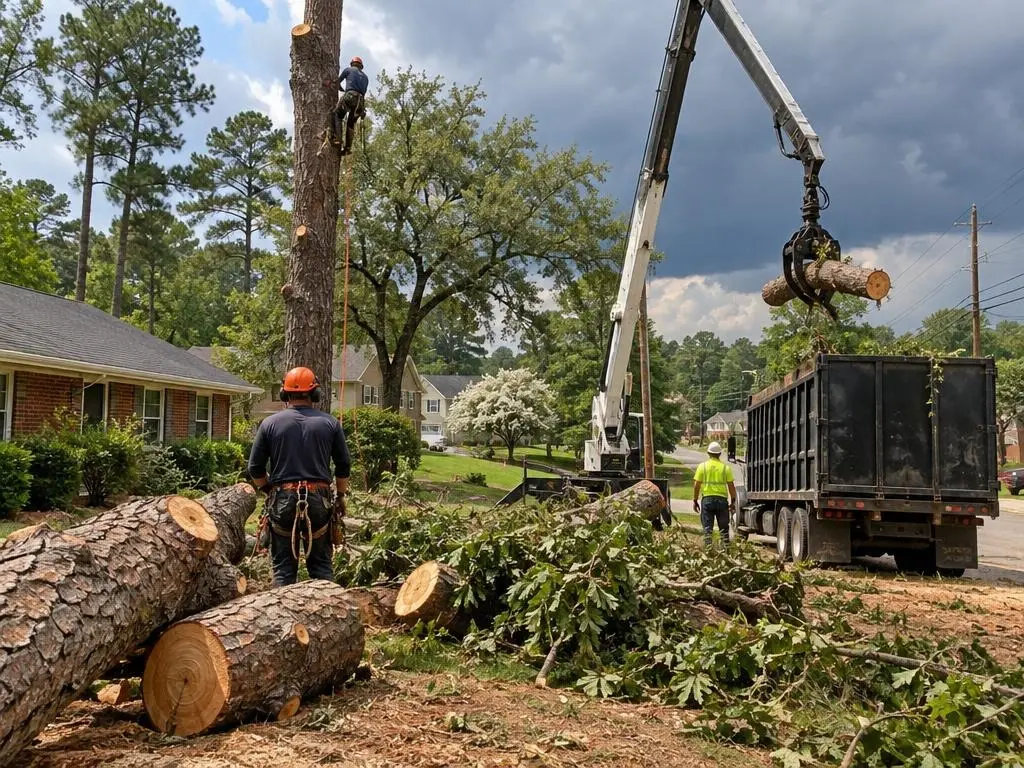
Tree Removal in Indian Land happens in an unusual setting: a community of 32,759 people (2020 census) with no municipal government. Indian Land sits in the northern panhandle of Lancaster County, about six miles east of Fort Mill and just west of Marvin and Waxhaw, North Carolina. U.S. 521 and S.C. 160 carry most of its traffic. In March 2018 residents voted on whether to incorporate, and about 83% voted no. So there is no town tree ordinance, no town public works department and no town brush truck. The rules that matter for a tree in your yard come from Lancaster County and, for most residents, from a homeowners association.
Growth you can see from the road
Lancaster County as a whole went from 76,652 residents in 2010 to 96,016 in 2020, a 25.3% jump, and the Census Bureau estimated 114,296 by 2025. Indian Land, the county's largest community, carried much of that. The panhandle is bounded on the west by the Catawba River and Sugar Creek, and many of the new neighborhoods between those streams and U.S. 521 went onto land that had been fields or woods.
What that means for your trees
New-neighborhood trees tend to fall into three groups, and each needs a different call:
1. Leftover woodland trees. Trees saved at the edges of lots during clearing often had roots cut or buried under fill. Many decline slowly and start shedding dead limbs years after the house is finished. 2. Exposed pines. Pines that grew up in a crowded stand and were suddenly left on their own are tall, thin and not used to full wind. They are worth checking if they can reach the house. 3. Builder-planted trees. Ornamentals and street-side trees planted close to driveways and foundations can outgrow their spot in 15 to 20 years. Sometimes pruning solves it; sometimes the tree is simply in the wrong place.
Working with your HOA
Most Indian Land subdivisions have covenants, and many require architectural or landscape approval before a tree is removed, especially a tree in the front yard or near a common area. Ask your management company before scheduling. We can give you a written estimate and a short note on the tree's condition, including photos of decay or damage, to attach to the request.
Storm work
Strong thunderstorms, the occasional ice event, and tropical remnants like Helene in 2024 all bring calls from the panhandle. If a tree is on your roof or across your driveway, stay clear, keep people out of the area and call (803) 752-2370. If lines are involved, the utility comes first.
The details we write into every Indian Land estimate
- Which trees come down and how (felled whole or taken down in sections)
- How the wood and brush leave the property, or stay if you want them
- Whether the stump is ground, and how deep
- Any sod, irrigation or fence considerations
Indian Land Background
- Unincorporated by vote. Indian Land is an unincorporated community; in a March 27, 2018 incorporation vote with about 42% turnout, roughly 83% of voters rejected becoming a town.
- Largest community in the county. Indian Land had 32,759 residents at the 2020 census and is named as Lancaster County's largest community; it lies about six miles east of Fort Mill.
- County growth. Lancaster County grew from 76,652 residents in 2010 to 96,016 in 2020 (25.3%), with a 2025 estimate of 114,296.
- River boundary. Lancaster County is bounded on the west by the Catawba River and Sugar Creek, the edge of the Indian Land panhandle facing York County.
Indian Land Questions
Does Indian Land have its own tree removal permit?
No town permit exists because Indian Land is not an incorporated town. For tree work tied to development or building permits, check with Lancaster County. For a tree on an existing home lot, your HOA covenants are usually the main thing to check.
My HOA wants a reason before approving a removal. Can you help?
Yes. Our written estimate can include a short description of the tree's condition and photos of any decay, dieback, cracks or lean, which is usually what an architectural committee wants to see.
The trees behind my house are on a common area. Can you remove them?
Trees on HOA common property belong to the association, so the association has to authorize and usually pay for the work. If one is threatening your house, report it to the management company in writing and keep a copy.
Who picks up tree debris in Indian Land?
There is no town collection service, so tree debris is handled by whoever does the work or by the homeowner. Our estimates include hauling the wood and brush away unless you ask us to leave firewood or a pile of chips.
Free Estimates in Indian Land, SC
Free estimates throughout Indian Land and the Lancaster County panhandle.
Tree Removal Near Indian Land
- Tree Removal in Rock Hill, SC
- Tree Removal in Fort Mill, SC
- Tree Removal in Tega Cay, SC
- Tree Removal in Lake Wylie, SC
- Tree Removal in India Hook, SC
- Tree Removal in Newport, SC
- Tree Removal in Lesslie, SC
- Tree Removal in Catawba, SC
- Tree Removal in York, SC
- Tree Removal in Clover, SC
- Tree Removal in Van Wyck, SC
- Tree Removal in Lancaster, SC
- Tree Removal in Chester, SC
- Tree Removal in Charlotte, NC
- Tree Removal in Ballantyne, NC
- Tree Removal in Pineville, NC
- Tree Removal in Matthews, NC
- Tree Removal in Weddington, NC
- Tree Removal in Marvin, NC
- Tree Removal in Waxhaw, NC
- Tree Removal in Belmont, NC
- Tree Removal in Gastonia, NC